
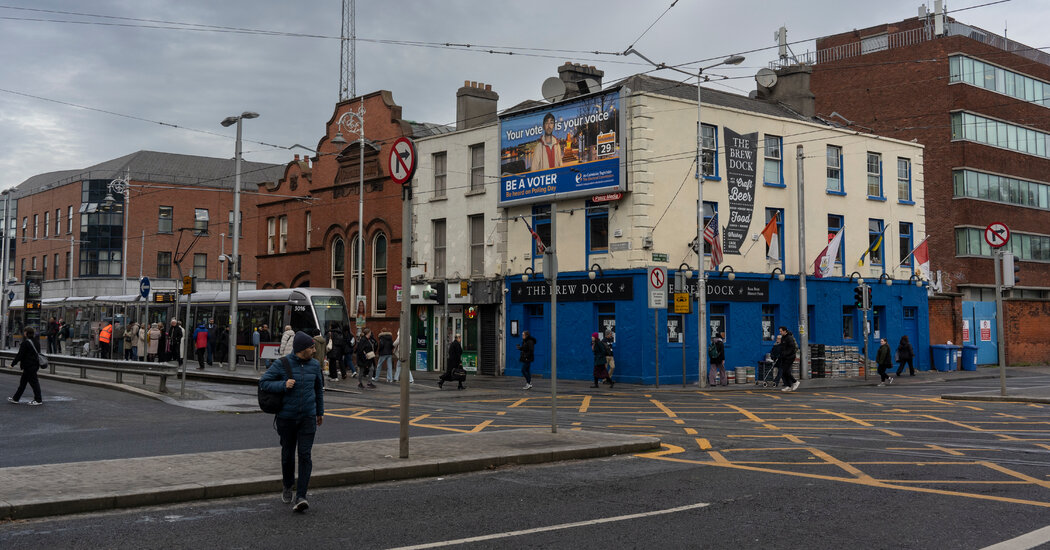
Voters in Ireland have set the stage for a return of the grand coalition government that has led their country since 2020, resisting an anti-incumbent wave that has swept across the United States and Europe.
The vote count was close on Sunday evening, two days after voters went to the polls, but the trend suggested that Ireland’s two main center-right parties had performed strongly enough to enter coalition talks — a process that could take weeks before the full shape of the government is clear.
Sinn Féin, the flagship Irish nationalist party, was on track to finish slightly behind the incumbents, Fine Gael and Fianna Fáil, a lackluster showing that will probably consign it to several more years in opposition.
At one level, the vote was an endorsement of continuity, delivering a result not unlike that of four and a half years ago. But the stability in Ireland’s political center ground masked volatility on the fringes, where anxiety over immigration fueled bids by several independents and other insurgent candidates.
With none of Ireland’s parties projected to gain enough seats to win an outright majority, a period of intense political horse-trading was always the most likely outcome of the vote.
The drama in the election, such as it was, was supplied by Sinn Féin, which had seemed a governing-party-in-waiting before collapsing in the polls earlier this year. It recovered some of its lost ground in the voting but fell short of a breakthrough and seemed likely to remain on the sidelines.
Ireland’s results, at the end of a record year of elections across the globe, underscored both how Irish voters are caught up in broader political currents and how their country remains somewhat distinctive.
Blessed with a prosperous economy, Ireland was not seized with the anti-incumbent fervor that toppled governments in Britain and the United States. Yet the fragmentation of politics throughout Europe has hit Ireland, too, leaving its three major parties unable to govern on their own.
Since the founding of the modern Irish state at the start of the last century, the two traditional parties — Fianna Fáil and Fine Gael — have governed during alternating periods. But after the last general election in 2020, neither won a big enough majority to govern alone, forcing them to enter a first-ever grand coalition, which also included the Green Party.
Their union resulted from the refusal of either party to enter into a government with Sinn Féin, which had won the popular vote for the first time. Once the political wing of the Irish Republican Army, Sinn Féin had long been on the fringes, seen by the political establishment as unpalatable. But the 2020 election underscored a deep well of popular support for the party and cemented its position as the largest opposition party in the Irish Parliament.
The leaders of Fianna Fáil and Fine Gael reaffirmed their ostracism of Sinn Féin before this election, even as polls showed that the three parties were on relatively even footing when it came to public support.
With around half of the seats announced on Sunday evening, Fianna Fáil was on track to win almost 22 percent of first-preference votes, Fine Gael nearly 21 percent and Sinn Féin around 19 percent.
Ireland’s proportional representation balloting, in which voters can rank their preference of candidates, often insulates it from the wild swings seen in other democracies — and in this election, that played out once again. But the fragmentation of the parties, and a restive public, opened the door to an array of fringe candidates.
In Dublin, for example, Gerry Hutch, a man prosecutors have described in court as the head of a crime family, narrowly avoided winning a seat. Mr. Hutch, known as The Monk for his ascetic lifestyle, ran in an urban district that was roiled by anti-immigrant riots last year. (Sinn Féin’s leader, Mary Lou McDonald, reclaimed her seat in the district.)
On Saturday, in Dublin’s central vote counting center, dozens of poll workers shuffled through long paper ballots, which were brought in sealed brown envelopes and dumped onto long tables to be tallied.
The flick of paper ballots, the scratch of pens on tally sheets and the chatter from activists who discussed the results in real time echoed through the large convention center hall.
“It’s particularly interesting to see democracy in process,” said Gerry Kearns, 67, who was volunteering to monitor the ballot tally. “And here, it’s so interesting to observe the count because of the transferable vote system.”
Mr. Kearns, a professor of geography at Maynooth University, chatted with an activist for Sinn Féin about the way the votes were playing out. They parted with a friendly farewell.
Lisa Keenan, an assistant professor of politics at Trinity College Dublin, said that in the run-up to the election, voters were clear that the rising cost of living was their main concern, an issue that has been animating electorates across Europe this year.
In the short three-week campaign period, the Irish electorate showed a remarkable degree of stability in its opinion of the major parties. As the last days of the campaign unfolded, however, Fine Gael’s support wobbled, amid a misstep by that party’s leader, Simon Harris, who is the taoiseach, or prime minister.
After a tense encounter on the campaign trail with a woman who protested that his government was not doing enough to support those who work with disabled people, as she does, Mr. Harris was forced to issue an apology.
Half of Fine Gael’s previous parliamentary party members chose to step down in this election, making the party’s fight for support an uphill battle. For a potential returning coalition government, there will be some immediate challenges.
The election of Donald J. Trump in the United States could threaten one of the sources of Ireland’s recent prosperity — its status as a low-tax European outpost for American multinational corporations — if Mr. Trump follows through on policies he has been weighing, like imposing tariffs or trying to repatriate money that comes from U.S. companies into Ireland.
Sinn Féin’s continued inability to vault into the government also underscores the relative quiescence of its core issue: unification of Northern Ireland with the Irish Republic. While a solid majority of people in the south favor unifying, according to polls, it scarcely figured as an issue in the campaign, falling far behind economic concerns and anxiety about immigration.